

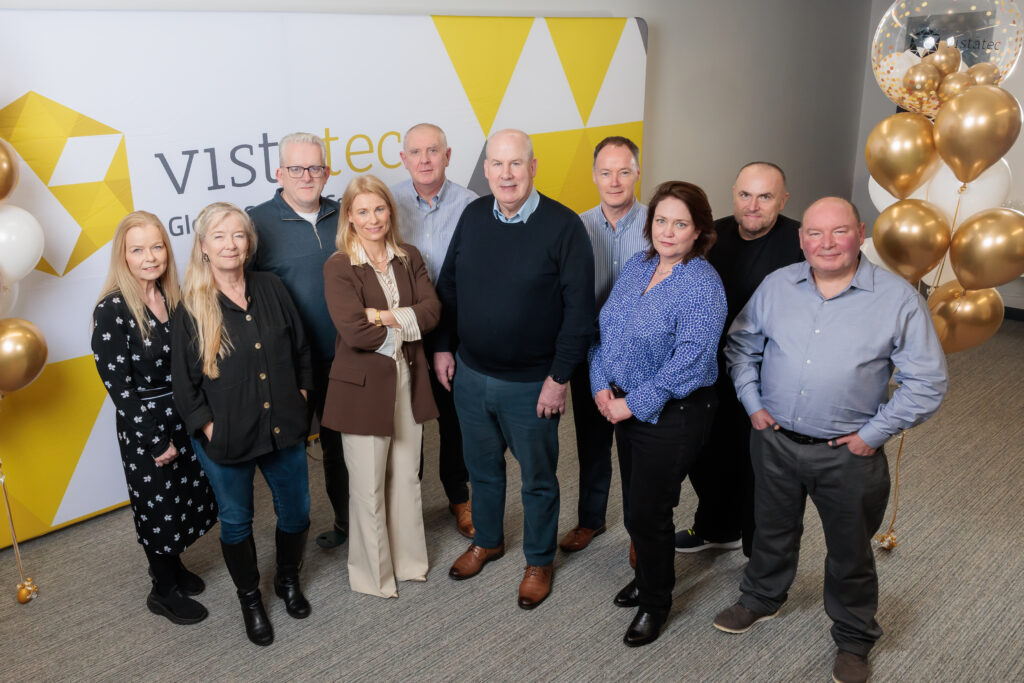
The localization industry moves fast. Twelve months ago, Vistatec appointed Caroline O’Connell as Chief Revenue Officer. The timing coincided with a key moment in the company’s almost 30-year history. Since then, Vistatec has opened a new global headquarters in Dublin and received multiple major AI industry awards.
Needless to say, it has been a busy first year in the job.
A Company in Motion
Vistatec’s move to The Eight Building in Dublin established our new global HQ, and this has led to further important work. The Vistatec AI services portfolio now spans LLM management, speech technology, verification tools, and governance frameworks.
Teams operate across 39 countries and continue to deliver at a high standard that few organizations at this scale can sustain. Caroline O’Connell stepped in and hit the ground running. Her background spans more than two decades in localization. She has deep experience on both the operational and commercial sides of the business.
The 2026 Artificial Intelligence Excellence Award, received earlier this year, brought some of that work into sharper focus. Judges specifically recognized Vistatec’s verification-first approach to AI and its deliberate emphasis on human expertise within automated workflows.
That distinction sets the company apart in an industry full of vendors racing to automate everything in sight. For more on Vistatec’s approach to AI quality assurance, see VistatecVerifier.
Caroline has a clear view of why that approach works.
AI in localization is not a replacement for expertise. It is a tool that performs well when qualified people design workflows, set parameters, and review outputs. The industry learned this the hard way in the early wave of neural machine translation. Vistatec drew the right conclusions from that period. The result is an AI infrastructure built around verification and accountability.
The Enterprise Buyer Has Changed
One of the clearest shifts O’Connell has observed over her first year is in how enterprise clients approach localization decisions. The conversation has moved significantly. Procurement discussions once centered on cost, turnaround time, and quality scores. They now reach into AI governance, data security, workflow transparency, and risk management.
This change is not unique to localization. Technology buyers across sectors have spent the past two years reassessing how they evaluate AI-enabled vendors. In localization, however, the stakes are particularly high. Content that crosses languages also spans legal jurisdictions, regulatory environments, cultural contexts, and brand risk.
A pharmaceutical company filing multilingual regulatory submissions operates with essentially zero margin for error. The same applies to a financial institution managing client communications across 20 markets.
Vistatec built its AI infrastructure with that reality in mind. Companies that took that approach early are finding the current enterprise buying environment far more manageable. Those that retrofitted compliance onto existing processes are facing a harder path.
Learn more about Vistatec’s AI Governance services and AI Gap Analysis.
What Actually Differentiates a Strong Localization Partner
Technology does not tell the full story by itself. The AI capabilities matter and the proprietary tools, too. The governance frameworks are crucial. But Caroline O’Connell’s first year has also reinforced something harder to measure. Culture is a real competitive differentiator, and it is almost impossible to fake at scale.
A global enterprise localization program is not a simple operation. Standard conditions include scope changes, tight deadlines, multi-market launches, regulatory complexity, and client-side pressure. Whether a vendor relationship holds up under that pressure depends less on the tools in use. It depends more on the people running the programs. Their judgment, standards, and commitment to delivery under difficult conditions determine the outcome.
This kind of quality only becomes visible when tested. Over the past year, it has been tested, and the results have been impressive.
Caroline’s commercial background is also relevant here. She has spent her career on the client-facing side of localization. That means she understands what enterprise buyers actually need, not just what vendors tend to offer. This perspective has sharpened how Vistatec approaches new business conversations.
Customers are not looking for a vendor that can describe its technology well. They are looking for a partner that understands their risk exposure, regulatory environment, and content complexity. Those are very different conversations, and they require a different kind of preparation.
Looking Ahead to LocWorld55 and Beyond
Vistatec heads into the second half of 2026 with a packed calendar. LocWorld55 takes place in Dublin, Ireland, in June. This is a very significant moment for both the company and the broader industry. The conversations there will influence how the sector approaches AI, partnerships, and responsible localization in the next phase. Global content complexity is only growing.
Caroline O’Connell will be very much a part of those conversations. After a year of learning the organization from the inside, she is well-positioned to represent what Vistatec has built and has in store.
The localization industry rewards longevity, but only when that comes with the willingness to keep evolving. Vistatec has been doing this for nearly 30 years, and the next phase of this hard work is well underway. To learn more about Vistatec’s localization services, visit the Vistatec services page. To speak to someone about what Vistatec can do for your organization, contact us today.