
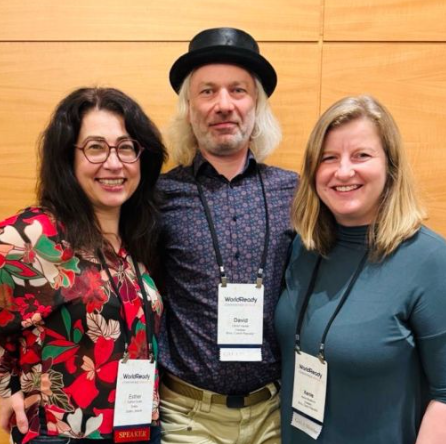
Vistatec attended the GALA WorldReady Conference in Berlin this April, joining hundreds of localization professionals across three days of sessions, workshops, and industry conversations. The conference, held at the Titanic Chaussee in Berlin, brought together language service providers, technology vendors, and enterprise localization teams at a moment of real change in the industry. Here is what Vistatec’s Xenie Musilova and David Vanek observed.
The Mood Around AI Has Shifted
The most notable change at this year’s event was the tone. In previous years, AI dominated the agenda with a mixture of resistance and anxious reassurance. This year, that has changed. The conversation is calmer, more grounded, and considerably more informed.
Companies of all sizes are now actively experimenting with AI, whether inside their internal processes or directly within translation workflows. Attendees spoke with real knowledge about where AI adds value and where human involvement remains necessary. A switch from anxiety to informed engagement says a lot about how the industry is processing the technology.
Clients Are Caught in the Middle
GALA also draws enterprise clients, specifically in-house localization professionals. Many of them are under mounting pressure from their own leadership to adopt AI faster. At the same time, they understand its limitations better than most.
Clients want the speed and cost advantages AI can offer. However, they also cannot afford poor quality outcomes. LSPs that position themselves on the opposite side of that tension risk being seen as a problem rather than a partner. The better model is straightforward: help clients understand what they want, what they actually need, what is available, and how those three things relate. That kind of advisory relationship is increasingly where LSP value lives.
Vistatec’s AI Consulting and AI Gap Analysis services are designed to support exactly this kind of client conversation.
Human Judgment Is Not Going Away
Several discussions touched on the future of the linguistic workforce. The picture is not one of replacement but of gradual change. Traditional forms of human involvement in translation workflows will reduce over time. However, new and adjusted forms of human contribution will take their place.
This is already happening and will continue. The keyword is progressive: not a switch that flips, but an ongoing evolution that requires the industry to adapt continuously. Linguists, project managers, and quality specialists are not becoming redundant, simply their roles are changing shape.
Tools like VistatecAIM and VistatecVerifier are built with this in mind, keeping human review and quality assurance central to AI-assisted workflows.
Key Takeaways for LSPs
The conference reinforced several practical priorities for language service providers:
- Develop genuine expertise in AI capabilities and limitations, not just talking points
- Shift from transactional service delivery toward advisory client relationships
- Build workflows where human judgment and AI automation each contribute where they are strongest
- Prepare for continuous change in how linguists and localization specialists work, rather than treating the current moment as a fixed state
Learn more about how Vistatec approaches AI in localization and our full range of AI services.