
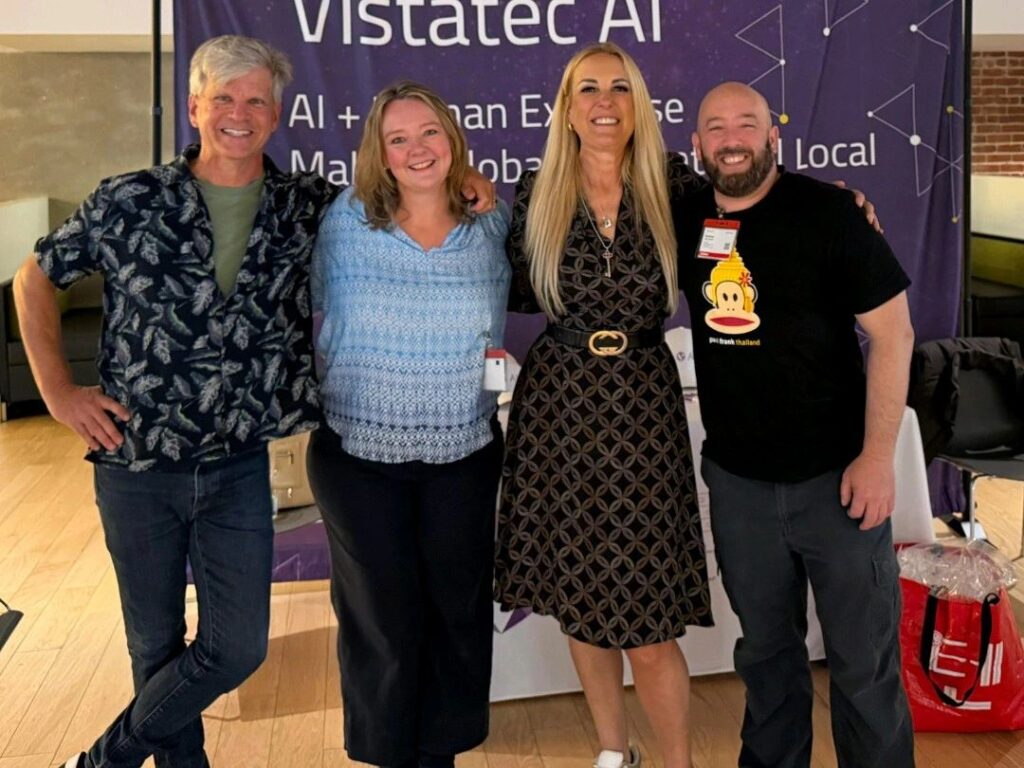
Gemma Newlove, Director of Sales at Vistatec, joined global localization and technology leaders at the GlobalSaké 2026 Annual Event on April 30 in San Francisco. Hosted in Adobe’s stunning glass atrium at 601 Townsend Street, the evening brought together professionals from across the globe to explore one defining question: how do organizations build multilingual, multimodal, AI-powered solutions that actually work at scale? Gemma co-moderated Roundtable Track 3, leading an open discussion on how teams and operating models must evolve to meet the demands of global-first, AI-enabled performance.
Here are the key themes that shaped the night’s conversations.
Human and AI Must Work as a Team, Not in Competition
The roundtables pushed back hard on the idea that AI is simply replacing human roles. The real challenge is role clarity: knowing where human judgment must remain in the loop to ensure quality, accountability, and trust. Multilingual quality management becomes critical in this context, providing the human governance layer that keeps AI-driven output reliable and on-brand.
AI Infrastructure Needs to Be Built for Continuous Localization
Platform teams can no longer treat localization as a downstream step. Roundtable Track 1 focused on designing AI infrastructure that supports real-time adaptation and circular global workflows from day one. Localization engineering sits at the heart of this shift, enabling organizations to integrate localization into their platforms rather than bolt it on after launch.
Data Governance Is a Shared, Cross-Functional Responsibility
The data track surfaced a major tension between centralized control and decentralized speed. The consensus leaned toward adaptive hybrid governance, where product, marketing, and localization teams share accountability for data quality and compliance. This is an area where AI governance frameworks help organizations maintain consistency without sacrificing velocity.
Cultural Intelligence Is an AI Imperative, Not an Afterthought
Track 5 drew on real case studies from gaming to show what happens when AI-generated content lacks cultural grounding. Geo-cultural context layers need to inform AI systems at every stage of production. Cultural adaptation services give organizations the structured approach they need to embed that intelligence at scale, not just catch issues at the review stage.
Products Must Be Designed for Geo-Fit From the Start
Track 4 challenged the one-size-fits-all product mindset. Teams that define market-specific value propositions, customer segments, and KPIs from the outset consistently outperform those adapting after launch. Translation and localization done right is not a finishing step. It is a strategic input that shapes how a product performs in each market.
The Next Generation of Localization Leaders Is Ready
GlobalSaké’s internship program was visible throughout the event, with students volunteering and participating alongside industry veterans. It was a strong reminder that the discipline is growing, and that the conversations happening in rooms like this one shape the standards the next generation will build on.
Vistatec is proud to have sponsored and participated in GlobalSaké 2026. If the themes above resonate with challenges your team is navigating, speak with one of our experts.
Curious how other global organizations have tackled these challenges? Explore our case studies to see what global-first success looks like in practice.