
AI in marketing is moving from experimentation to execution. At this year’s 3XE Digital AI Conference in Dublin, that shift was unmistakable. Instead of chasing the latest tools, speakers, and attendees focused on skills, strategy, and responsible implementation that actually move the needle for businesses.
For Vistatec, it was a pulse check on where Irish and European marketers stand with AI right now. Fear and hype are giving way to a more grounded question: how do we use AI well, without losing sight of trust, creativity, and results?
Overview
- A day focused on practical AI, not buzzwords
- Shared themes
1. Education as the real AI advantage
2. Strategy before tools
3. Search, PR, and brand signals in the AI era
4. Responsible, governed AI for marketers
5. Automation, operations, and time back for teams
6. Content that connects, not just content that ships - Event snapshot
- Takeaways for the year ahead
Designed for learning, not just demos
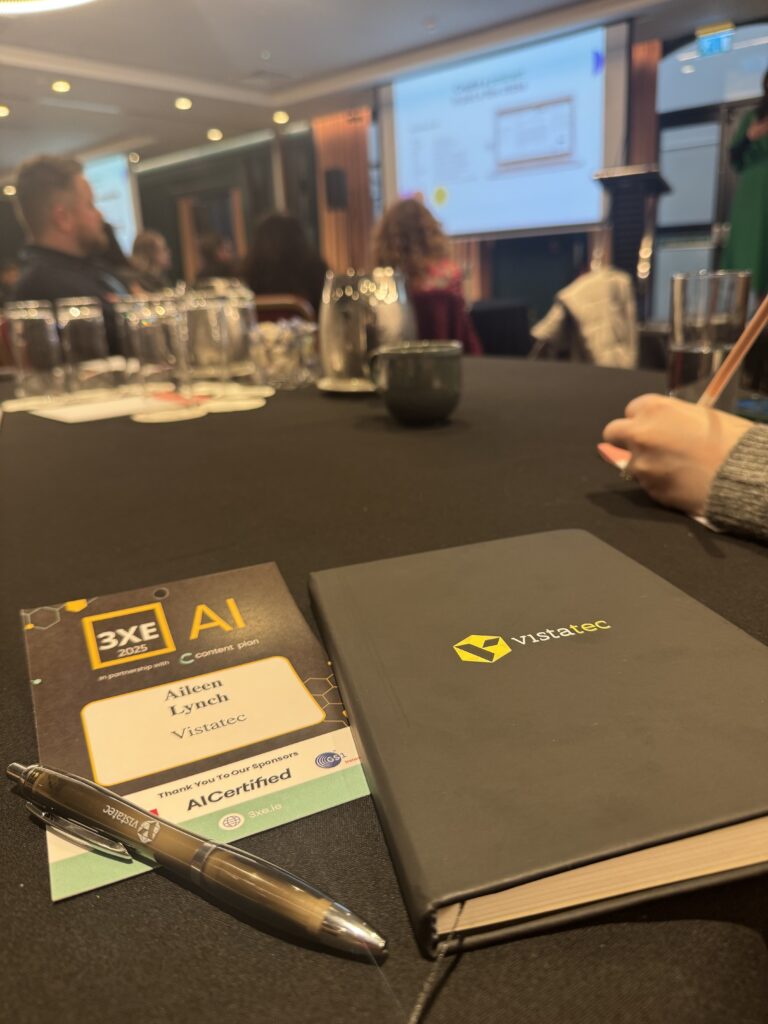
From the opening keynote onwards, education and capability were mentioned repeatedly.
Ray Grafton from AiCertified opened with a clear view of what is changing. In his words, the real performance gap in 2027 and 2028 will be between AI-native teams and AI-lagging ones. Not because one group has better tools, but because they have better skills and structure.
He set out a simple idea that echoed through the rest of the day: AI competence will matter more than tool choice. Without education, strategy, and governance, even the best platforms will underperform.
1. Education as the real AI advantage
Ray’s talk framed AI as a capability shift, not a software purchase.
- AI power and multimodal models are scaling quickly, but team literacy is not.
- Entry-level, knowledge-based roles will change or disappear, putting greater pressure on upskilling.
- The greatest risk for companies is not AI itself, but the skills gap that results if they do nothing.
Unstructured learning was highlighted as a silent blocker. If teams pick up tips from social media and vendor pitches without a proper roadmap, adoption stays shallow. Clear progression paths, internal standards, and structured learning were presented as the way to turn anxiety into confidence.
2. Strategy before tools
Several sessions pushed back on jumping straight into tools.
Naomh McElhatton’s talk on “Strategy before utilisation” was a potent reminder that AI without a plan rarely delivers ROI. Her focus was simple and very practical.
- Get your data in order
- Know what success looks like before you start
- Match AI use cases to clear business outcomes
She pointed attendees to the EU AI Act resources and other training materials, not as a means of legal compliance, but as guidance for responsible and sustainable AI use. The message was that hyper-personalized experiences are on the horizon, but they must be built on a foundation of clean data and sensible objectives.
3. Search, PR, and brand signals in the AI era
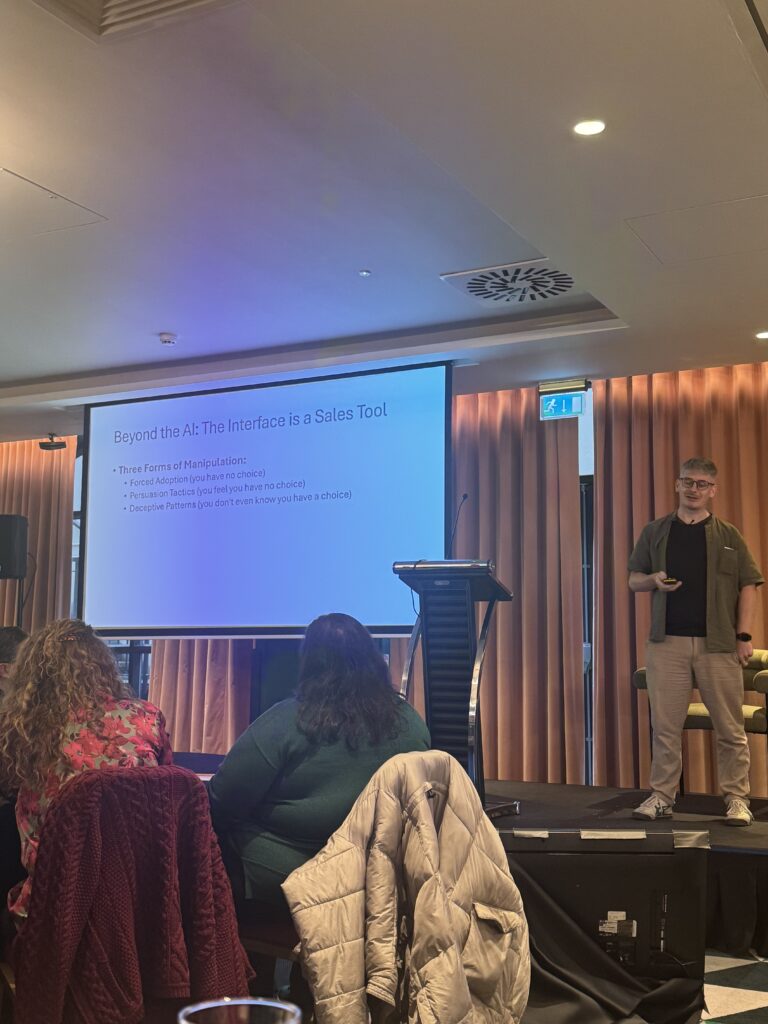
In his session on strategy in the age of AI, Gavin Duff highlighted a shift that many marketers are only just beginning to understand.
Search has not disappeared. It has fractured across platforms, devices, and AI experiences. That means AI systems now care more about what others say about your brand than what you say about yourself.
Key points included:
- Independent reviews, third-party mentions, and industry articles are becoming central brand signals
- Public relations and thought leadership are critical inputs for AI systems that summarise “who you are.”
- Content still has to be original, story-driven, and worth sharing by a human standard
As Gavin put it, you should only publish content you would be willing to share yourself. Volume without value is more likely to be ignored by both people and machines.
4. Responsible AI and compliance
Several speakers touched on regulation, governance, and trust.
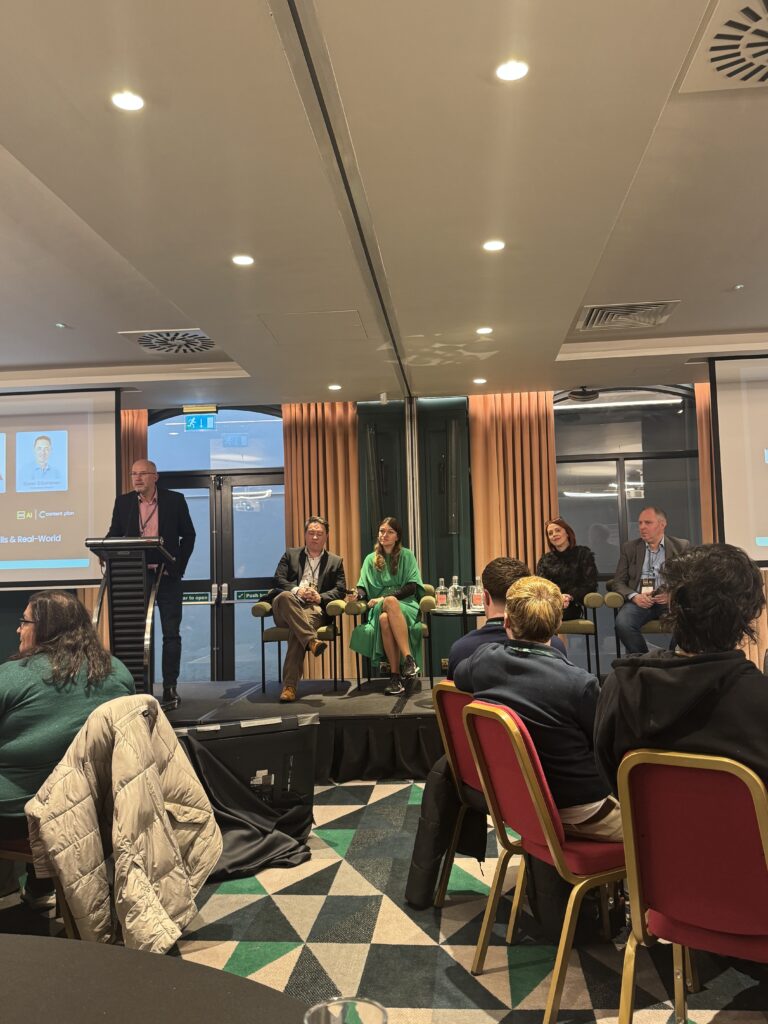
Boris Gersic framed the problem as a capabilities gap, not a tools gap, and stressed the need for a governed creative pipeline. Colin Cosgrove then walked through the EU AI Act and made the case that responsible AI is not something to bolt on later.
Even a short, two-page document outlining your initial responsible AI plan is better than waiting for the perfect framework. Small companies and large enterprises alike will need to show how they manage risk, explain decisions, and keep humans in the loop.
Across talks and panels, trust emerged as a key theme, particularly in how AI is used internally and in the trust customers will increasingly place in companies to ensure their data and experiences are shaped ethically.
5. Automation that gives time back
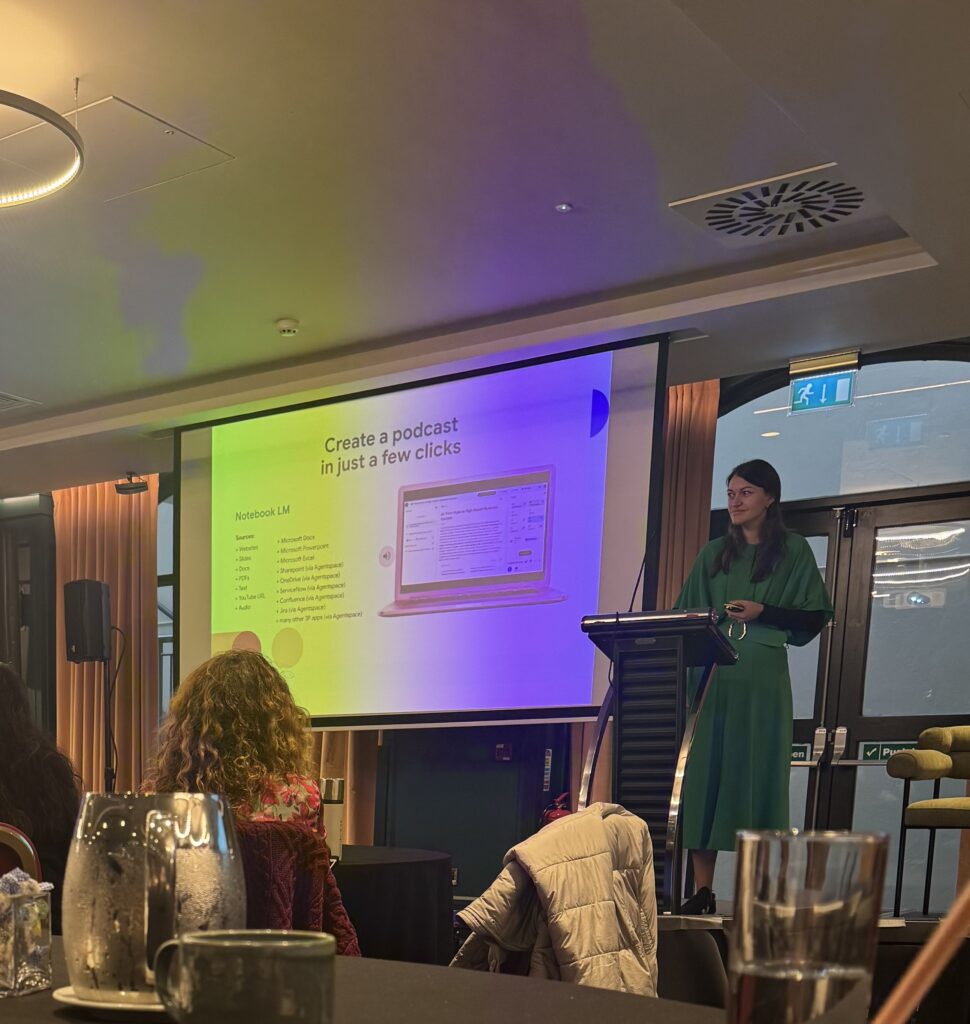
On the operational side, Denis Jastrzebski showed how tools like ChatGPT and Zapier are already handling real workflows for Irish businesses.
If a task is repetitive, data-intensive, and occurs weekly, it is a candidate for automation. Examples included client onboarding flows and document generation, which previously required many hours of manual work.
For marketing teams, this kind of automation is less about cutting headcount and more about freeing people to focus on strategy, creative work, and analysis.
6. Content that actually connects
To close the day, Clark Boyd focused on social media and content quality in an AI-saturated environment. His advice was:
- Posting more is not the same as reaching more
- Platform-specific content matters more than ever
- New KPIs are emerging around dwell time, conversation, and meaningful engagement
AI can help with research, outline creation, and repurposing, but it cannot care. That human layer, the decision about what is worth saying and why, still sits with marketers.
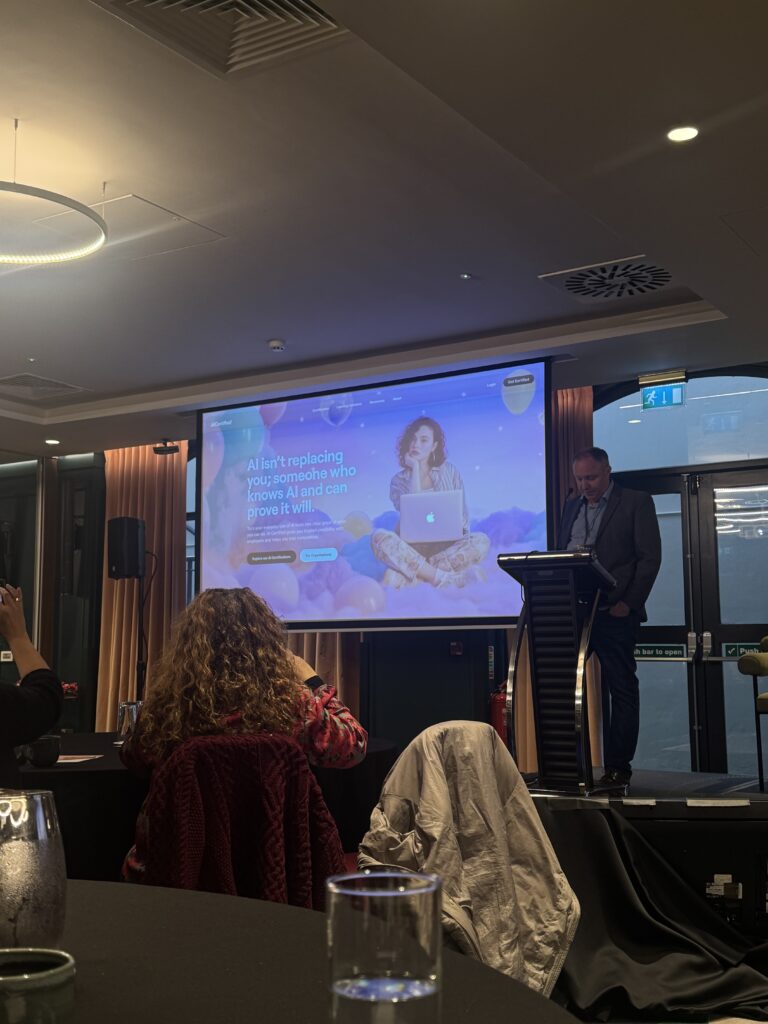
Event snapshot
- One day, a Dublin-based AI in marketing conference
- Speakers from AiCertified, Google Cloud, Women in AI, Friday Agency, The Corporate Governance Institute, GS1 Ireland, and others
- Focus on education, strategy, compliance, and practical workflows
Takeaways for the year ahead
1. Skills first, tools second
Teams that invest in AI education and structure will outpace those that simply “add another tool.”
2. Strategy is non-negotiable
Clear goals, good data, and governance are now table stakes for serious AI use.
3. Brand signals matter
Reviews, PR, and independent mentions are becoming critical inputs for how AI systems understand your business.
4. Compliance is a competitive edge
A responsible AI plan will increasingly support trust with regulators, clients, and partners.
5. Human connection still wins
Automation can handle repetition. Marketers still hold relevance, empathy, and long-term relationships in high regard.
For Vistatec, 3XE Digital reinforced what we are seeing with our own clients. The organizations that will win with AI are not those chasing quick hacks, but those building thoughtful, governed, and AI and human programs that work.